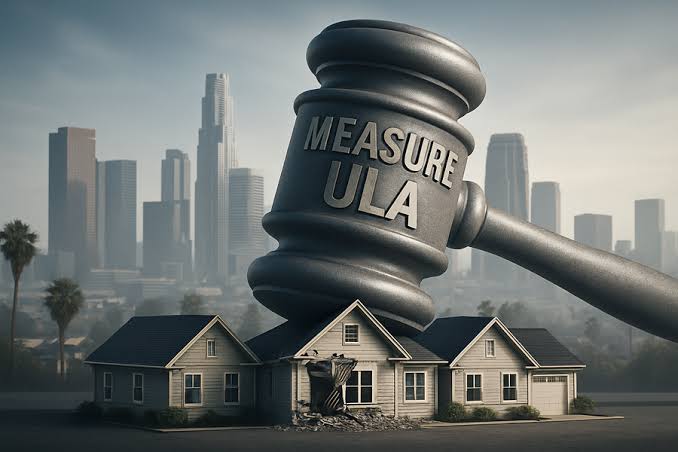
Voters called it the “mansion tax,” but most of what Measure ULA collects doesn’t come from mansions. Since April 2023, ULA has added a large transfer tax to every property sale in the City of Los Angeles above a set price, and that includes apartment buildings. For owners of larger multifamily properties, it has become one of the biggest costs of selling.
Here is where things stand as of September 2026.
ULA is paid by the seller at closing. It comes on top of the standard transfer taxes: the City of LA’s $4.50 per $1,000 and the County’s $1.10 per $1,000. For sales closing after June 30, 2026, the rates are:
The thresholds started at $5 million and $10 million, and they rise every July 1 with inflation. Check the current figures before you price a property.
The most important thing to understand about ULA is that it isn’t a marginal tax. Once a sale crosses the threshold, the tax applies to the entire price, not just the amount above the line.
Here’s how that plays out, using the standard City and County taxes plus ULA:
Selling for $50,000 more costs the seller about $218,000 in extra tax. To net the same amount as a $5.4 million sale, a seller needs a price of roughly $5.63 million. Anything between those two numbers leaves the seller with less money, not more.
The same thing happens at the upper threshold. Crossing $10.9 million adds almost a full point of tax on the whole price, so a seller needs a price above roughly $11.07 million to come out ahead of a sale just under the line.
The cliff has created a dead zone in pricing. Buildings that would naturally trade a little above the threshold often list or close just under it instead, and sellers and buyers negotiate around the line. Some larger owners who don’t have to sell have chosen to hold, refinance, or wait for the rules to change. That has reduced the number of higher-priced apartment sales in the city.
Location matters too. ULA applies only inside the City of Los Angeles. Neighboring cities such as Santa Monica, Culver City, Beverly Hills and West Hollywood are outside it, though several of them have transfer taxes of their own on higher-value sales. Two buildings a mile apart can have very different closing costs depending on which side of a city line they sit on.
This year brought several attempts to change ULA. None of them has changed the tax yet:
The bottom line for now: ULA remains in effect at full strength, and anything that changes it is still at least months away.
If your building could be worth more than $5.4 million, these are the questions to work through before you list:
Always check with your tax advisor and attorney before you structure a sale around ULA.
The James Group has helped Los Angeles apartment owners price and sell buildings on both sides of the ULA thresholds. If you’re thinking about selling, request a free property evaluation and we’ll show you where your building fits and what you’d net at different price points.
 Peter James
Peter James is a First Vice President at Lyon Stahl Investment Real Estate and Co-Founder of The James Group, a leading Los Angeles, based investment brokerage team specializing in the sale of multifamily properties. Since beginning his career in 2007, Peter has built a strong reputation as a trusted advisor in the Los Angeles apartment market, with deep experience across the Westside and surrounding submarkets.
Peter advises investors on the acquisition and disposition of multifamily assets throughout Los Angeles County. His approach combines detailed financial analysis, real-time market insight, and a clear understanding of investor objectives, allowing him to guide clients through both straightforward and highly complex transactions.
In addition to traditional multifamily brokerage, Peter has extensive experience structuring and executing 1031 exchanges, including transitions into single-tenant NNN properties and Delaware Statutory Trust (DST) investments nationwide. His ability to navigate tax-deferred strategies and long-term portfolio planning has helped clients preserve capital, increase cash flow, and achieve greater flexibility across market cycles.
As Co-Founder of The James Group, Peter has helped build a collaborative, high-performing team known for integrity, disciplined execution, and market expertise. He maintains strong working relationships with lenders, attorneys, and qualified intermediaries, ensuring that each transaction is coordinated efficiently and aligned with his clients’ broader financial and investment goals.
Outside of real estate, Peter enjoys spending time outdoors with his wife, Jessica, and their daughters, Dylan and Daphne. Whether surfing, snowboarding, or exploring the California coast and mountains, family and an active lifestyle remain central to his life. Peter is a graduate of the University of California, Riverside.